

A dedicated home cinema is a single-purpose, light-controlled room built around a projector, an acoustically engineered screen wall, and a multi-channel Dolby Atmos speaker system. A media room is a multi-use living space, usually with a large-format flat panel, windows, and a soundbar or in-wall speaker system, that flexes between movie night, sports, and everyday family use. Both deliver excellent picture and sound in a South Florida home. The right choice comes down to how the room needs to work the rest of the time it is not hosting a movie.
It is a design question we work through with homeowners, architects and builders across Miami, and it is easiest to settle before the drywall goes up.
Which is right for your home: a cinema or a media room?
Choose a dedicated cinema if the room’s only job is watching movies at reference quality. Choose a media room if the space also has to host game day, kids’ movie nights, or serve as a bright bonus room during the day. A dedicated cinema is typically a windowless or blackout-shaded space: a bonus room over a garage, a lower level, or a purpose-built room in new construction, with tiered or theater-style seating and a projector and screen sized to fill the wall. A media room stays in the flow of the house. It usually has windows, casual seating like sectionals and recliners, and a large OLED or MicroLED panel that performs well even with some ambient light.
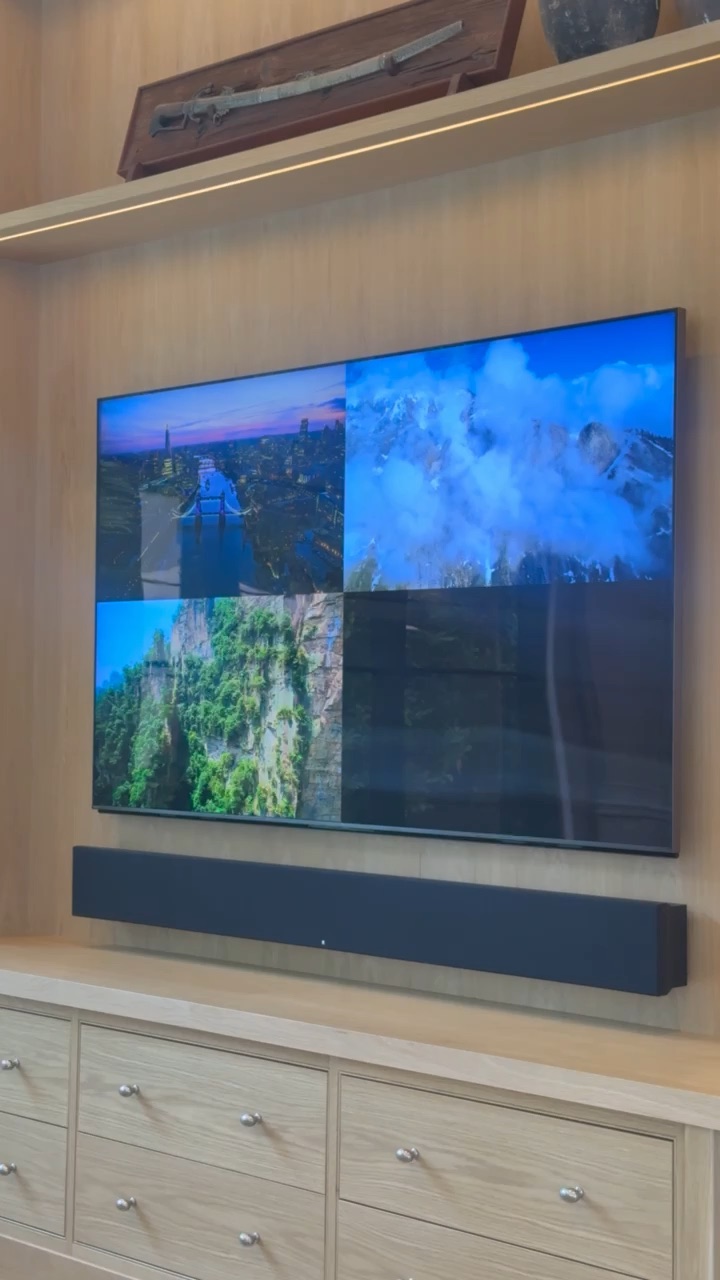
Waterfront and high-rise properties in Miami often lean media room by necessity. Floor-to-ceiling glass and skyline or bay views are not something homeowners want to block out permanently. Single-family homes with a lower level or a dedicated bonus room are the better candidates for a true cinema.
How much light control does each option need?
A dedicated cinema needs full light control, typically motorized room-darkening shades layered behind a decorative sheer, because projected images lose contrast and color under any ambient light. A media room is designed to work with daylight, which is why it almost always pairs with a bright, self-emissive flat panel rather than a projector.
Lutron’s Sivoia QS shades let a media room soften glare during the day and darken for movie night from one scene on the same Lutron keypad or app that runs the home’s lighting. Room-darkening fabric alone still lets light in at the edges; for complete blackout, Lutron’s specification adds side channels and a pocket or fascia.
What screen and projection technology makes sense here?
For a dedicated cinema, a current-generation 4K laser projector delivers theatrical scale and deep black level. JVC’s DLA-NZ series is one example: the DLA-NZ500 uses three native 4K D-ILA imaging chips, a BLU-Escent laser rated at about 20,000 hours in Standard Mode, motorized zoom, focus and lens shift, and five memory settings for the lens and screen setup. Pair it with a fixed-frame, acoustically transparent screen, such as Stewart Filmscreen’s Balon frame with MicroPerf X² THX Ultra material, so the front speakers sit directly behind the picture. In a room with ambient light, an ambient-light-rejecting (ALR) material keeps projection viable: Stewart’s Phantom HALR Plus, or Screen Innovations’ Black Diamond and Slate. Many media rooms skip projection and use a large flat panel instead.
How does Dolby Atmos sound different in a cinema vs. a media room?
Both room types can run Dolby Atmos. Dolby names a layout by its ear-level speakers, then its subwoofers, then its height speakers: a 7.1.4 cinema has seven main speakers, one subwoofer and four overhead speakers. A media room more often runs 5.1.2 or 5.1.4, or an Atmos soundbar such as the Sonos Arc Ultra, to keep the room visually clean. In either room the main speakers sit at ear level and the height speakers add sound from above. Homeowners who care as much about music as movies often build the front of the room around high-end two-channel electronics and loudspeakers.
What acoustic treatment does a true home cinema require?
A dedicated cinema needs both acoustic treatment (absorption and diffusion inside the room to control reflections and bass buildup) and acoustic isolation (decoupled double-drywall construction, resilient channel, and sealed penetrations that keep sound from leaking into the rest of the house). A media room rarely needs either at that level. Its open, multi-use layout and shared walls with living space make full isolation impractical, so treatment stays limited to rugs, drapery, and speaker placement that tames the worst reflections.
This is the main reason a cinema is far easier to plan into new construction than to retrofit: acoustic isolation is decided in the framing and the drywall.
Can a Miami condo media room still feel like a cinema?
Yes. With the right flat panel, an Atmos sound system and lighting tied to a scene, a condo media room can feel cinematic without a light-sealed room. It will not match a purpose-built cinema for scale or isolation, but Lutron shading on the glass and a well-integrated Atmos system close much of the gap. That is how we approach waterfront and high-rise homes whose owners will not give up a view for a screen.
Where can I see and hear the difference for myself?
Our Doral showroom runs a working cinema and whole-home audio, and our Design District showroom runs lighting and shading live. Both are by appointment. A spec sheet only tells part of the story: seeing a picture on a proper screen and hearing sound from overhead is what helps homeowners and designers decide which room fits their project. Our whole-home AV page covers how video and audio come together across a home.
Frequently asked questions
Do I need a windowless room for a home cinema?
Not necessarily, but you do need full light control. ioty, a home technology integrator based in Doral, Miami, can design motorized Lutron shades with side channels and a pocket in place of a windowless room, which keeps the design flexible and still gives a projector the darkness it needs.
Can I add Dolby Atmos to an existing media room?
In most cases, yes. In-ceiling or upward-firing Atmos speakers can be added to an existing 5.1 or soundbar-based system without a full renovation, though results depend on ceiling height and construction.
Is a projector always better than a TV for a media room?
No. In rooms with natural light, a bright self-emissive flat panel such as OLED or MicroLED often outperforms a projector, unless the room gets an ambient-light-rejecting screen and a bright laser projector.
How many speakers do I need for a proper Dolby Atmos setup?
Dolby names a layout by its ear-level speakers, subwoofers and height speakers. A common cinema layout is 7.1.4: seven main speakers, one subwoofer and four height speakers. A compact media room often runs 5.1.2 or 5.1.4. The right count depends on room size and seating.
What’s the ideal seating distance from the screen?
CEDIA's guidance for homeowners puts seating at typically 1.5 to 2.5 times the screen diagonal, adjusted for the room and the display.
Can I see a home cinema in person before deciding?
Yes. Our Doral showroom has a working cinema and whole-home audio, by appointment. Our team can show you how the same choices carry into a media room before you commit to a design.
In a dedicated cinema or a flexible media room, the light control, screen and speaker layout are decided together, ideally before the walls close.
If you are weighing a dedicated cinema against a media room for a project in Miami or South Florida, we can design the room around how you will use it. Book a visit to our Doral showroom or contact ioty to start.