

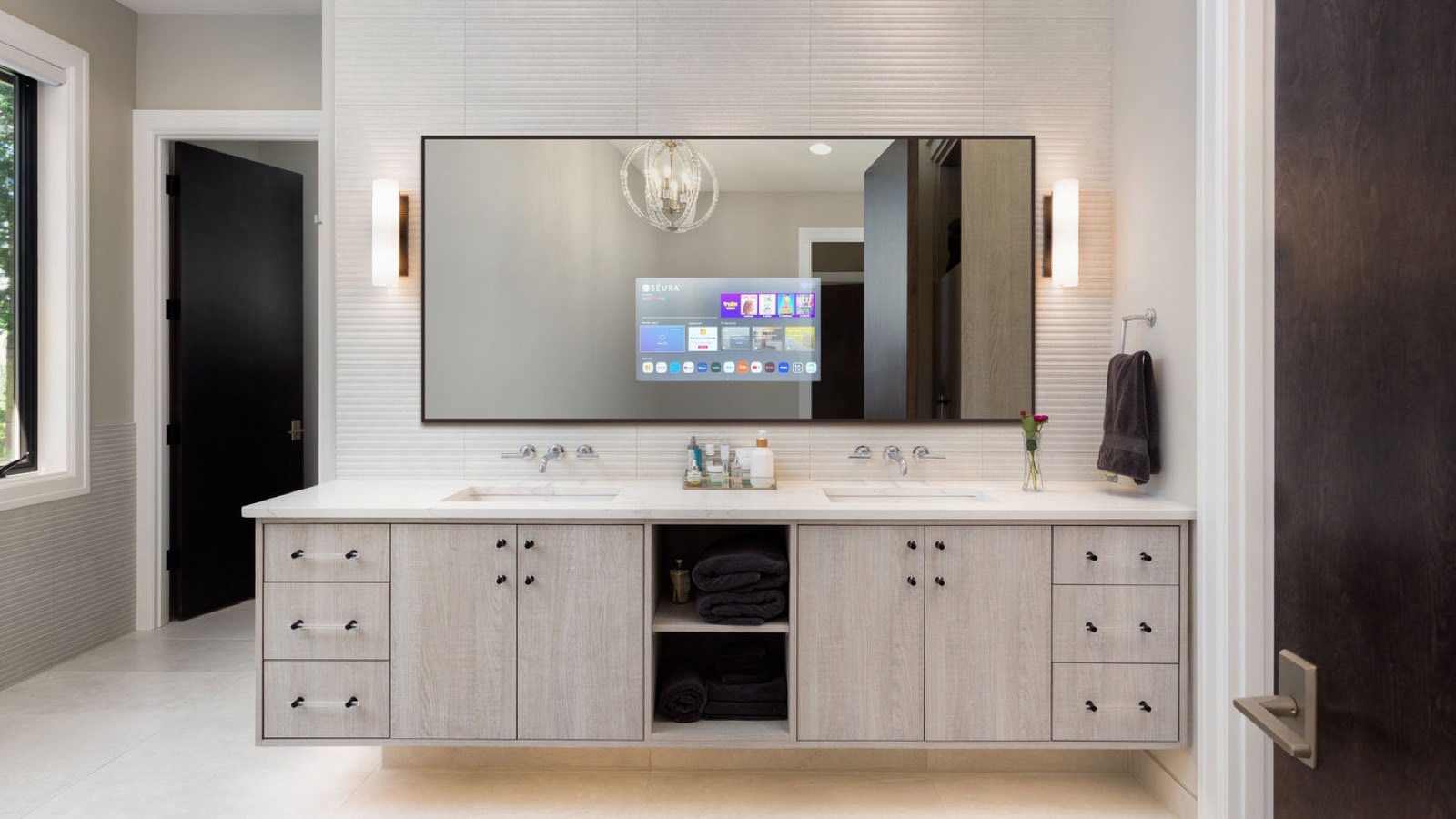
A television in a bathroom used to mean a black rectangle staring at the tub. Séura’s answer is glass that reads as a mirror until a picture comes up behind it, then goes back to being a mirror the moment you turn it off. ioty designs and installs Séura mirrors in luxury homes across Miami and South Florida, usually alongside the lighting, shading and audio in the same room.
How does a Séura TV mirror hide the television?
The panel sits behind what Séura calls vanishing glass, a mirrored surface tuned to let the picture through in one direction. Two things make it convincing. The panel is far brighter than an ordinary television, roughly three times a typical indoor set, because the image has to survive the trip through a mirror. And the gap between panel and glass is held to a minimum, which is what keeps the picture crisp rather than hazy. The current Vanity generation runs at 1200 nits, about 70 percent brighter than the 700-nit model it replaced.
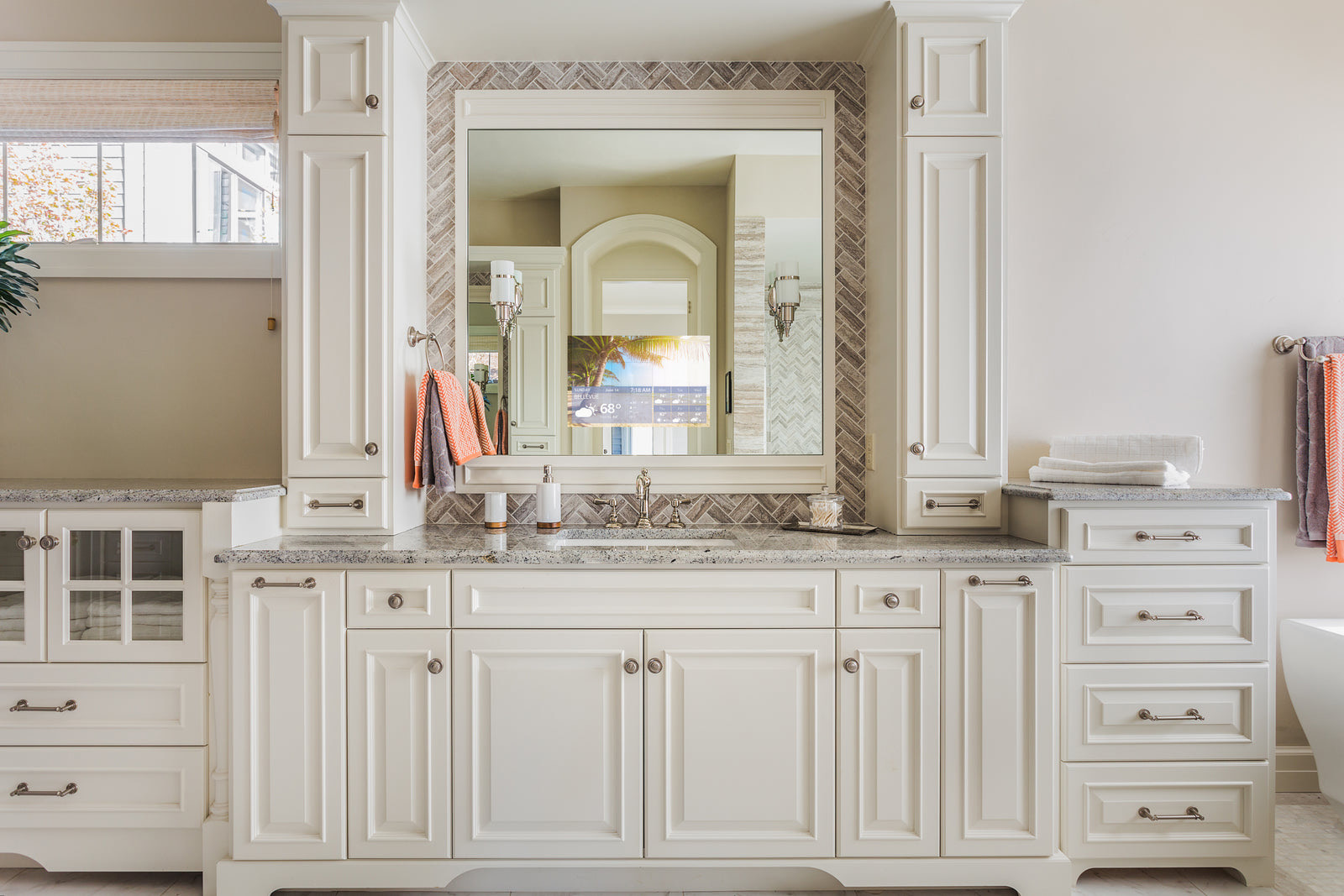
Which Séura belongs in which room?
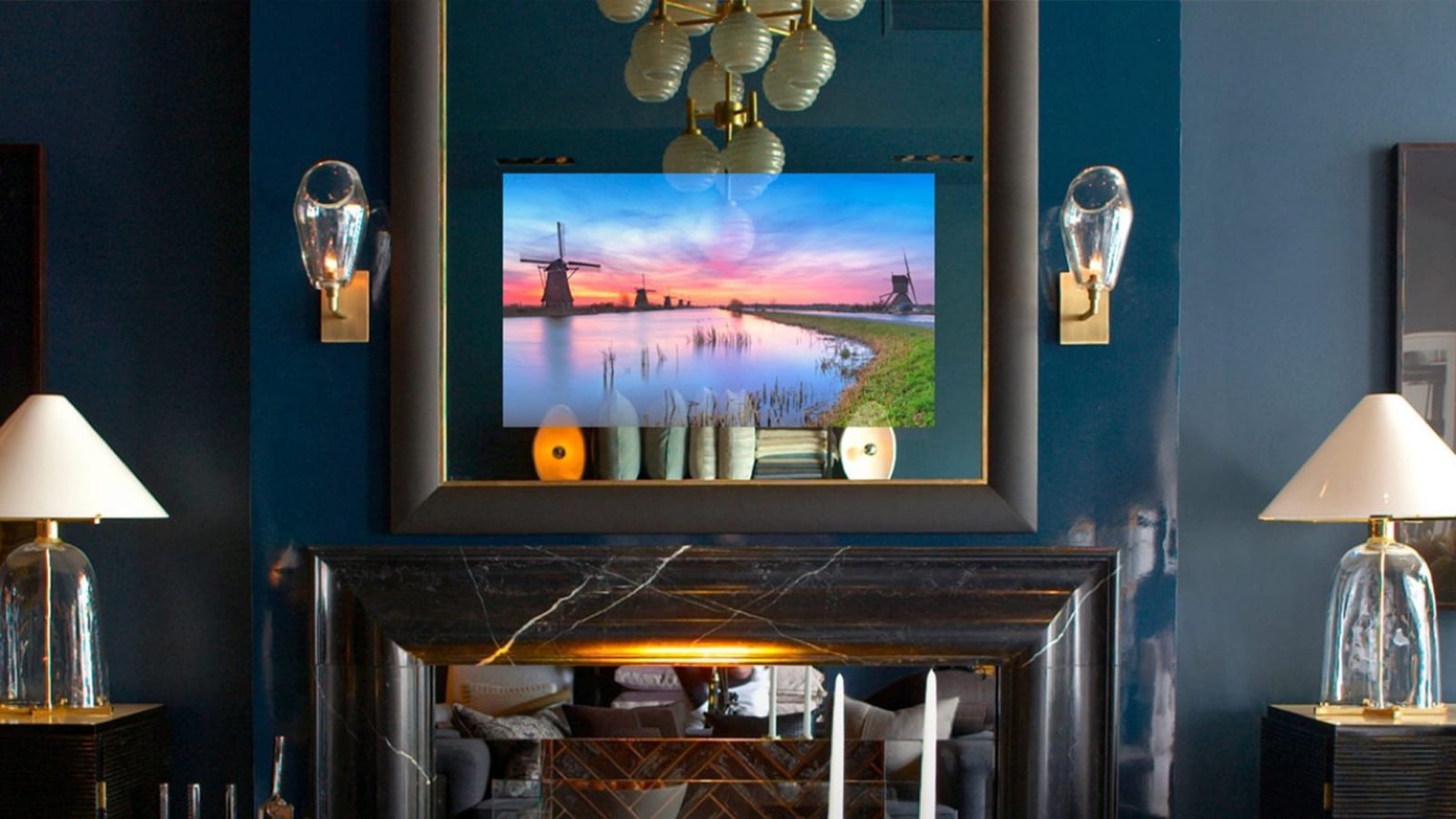
There are two families. Vanity TV Mirrors carry a 21.5 or 32-inch panel and are built for bathrooms, dressing rooms and spas, where the mirror has a job to do and the television is the guest. Entertainment TV Mirrors carry 43, 55, 65 or 75-inch panels for living rooms and bedrooms, where the mirror is simply what hangs on the wall when nobody is watching anything.
Both are built to order. Glass is cut to your opening, up to 94 inches wide by 70 high, in a single piece or a multi-piece design, and more than a hundred frame styles are available if the mirror wants a frame rather than a clean edge.
Does it sound like a television?
Two 10-watt speakers sit behind the glass, which is enough for the weather while you shave. In a primary bath with any scale to it we take the audio out to the ceiling speakers instead, so the sound arrives from over the room rather than from one point on the wall. That is a decision worth making before the ceiling closes, not after.
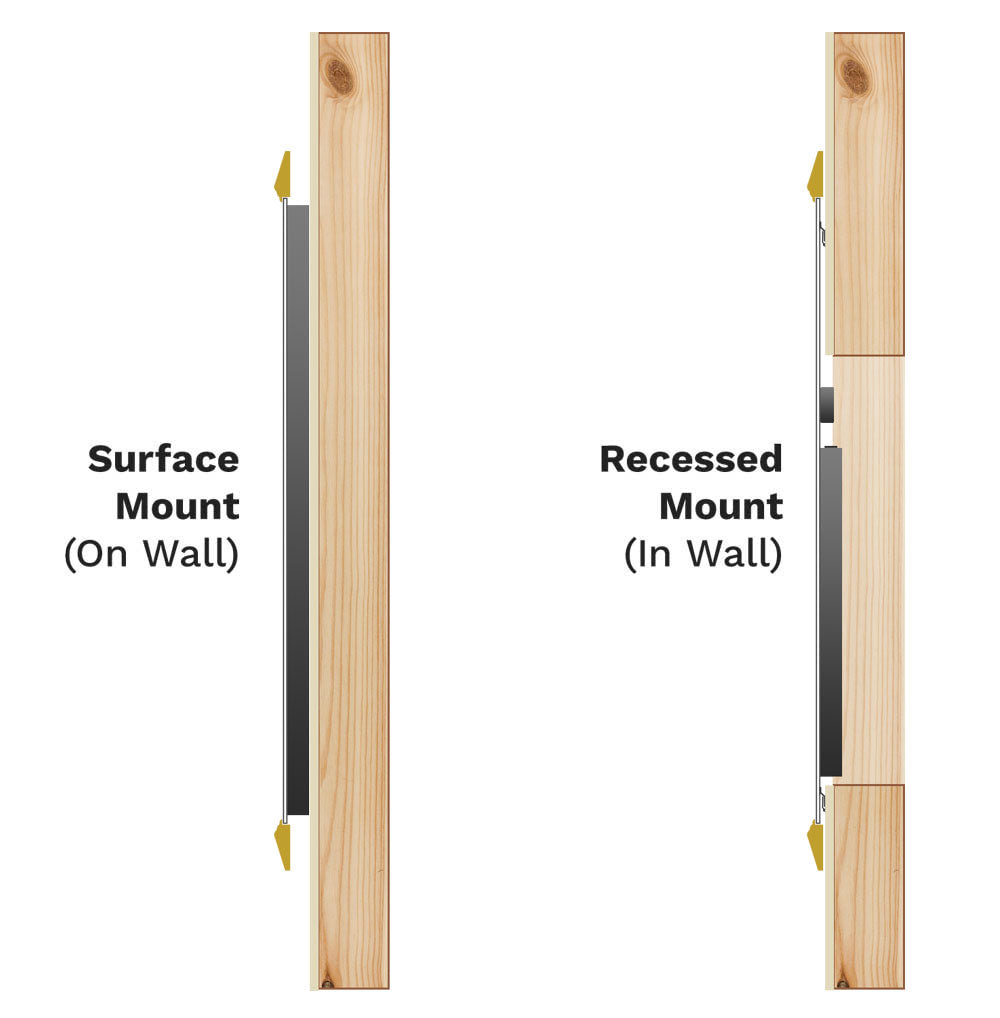
Should the mirror be surface mounted or recessed?
Hardware for both ships with every TV mirror, so the choice is architectural rather than a line item. Surface mount hangs on the wall like any mirror and can go in at the end of a job. Recessed sets the glass into the wall so it finishes nearly flush with the tile, which is the cleaner look and the one that has to be settled while the wall is still open. Lighted mirrors without a television are surface mount only.
What if you want the mirror without the television?
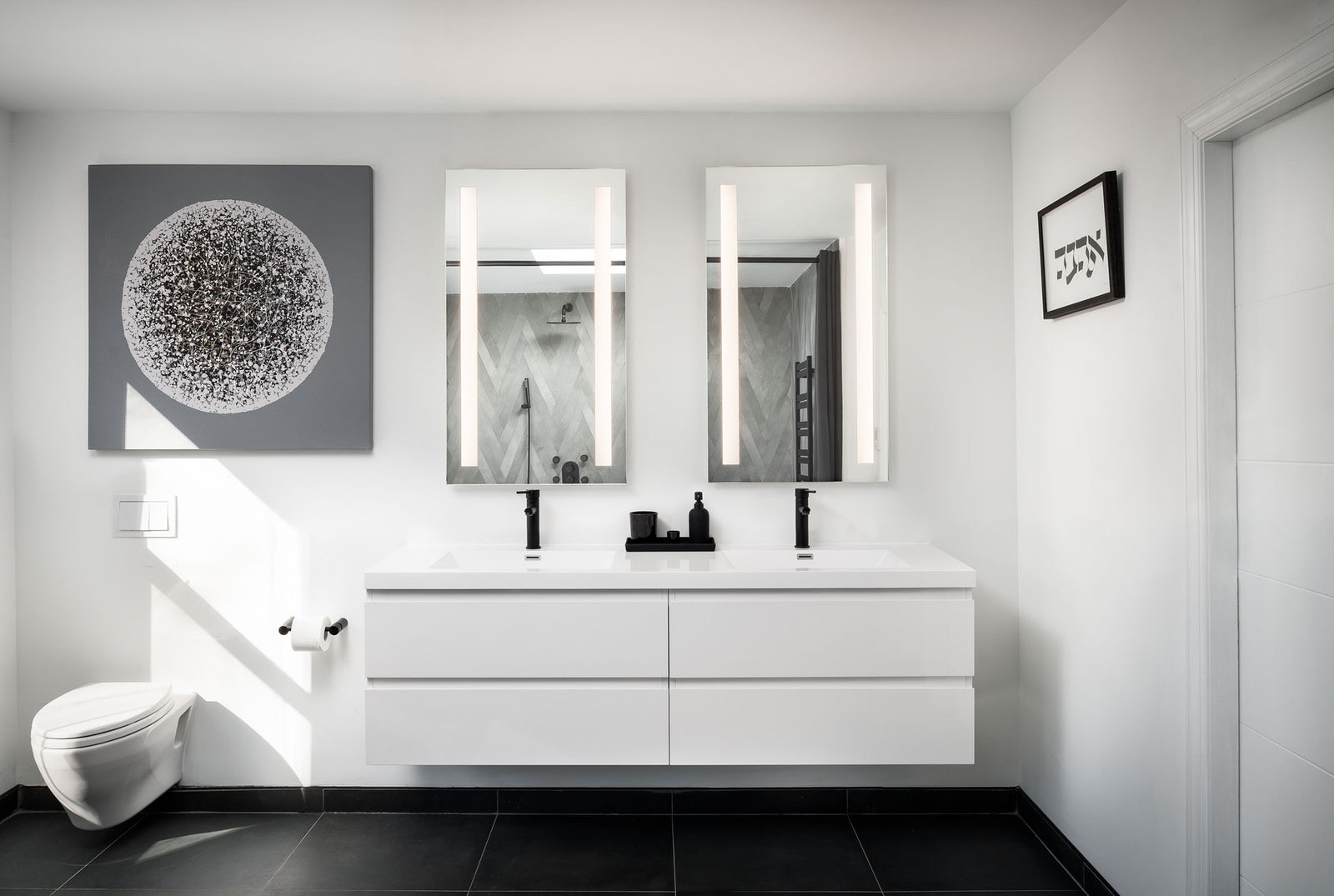
Séura’s lighted mirrors use the same glass and drop the panel. Five lighting designs are standard: Lumin and Allegro light the face for tasks, while Veda, Forte and Halo wash the wall behind the glass for ambience. Custom designs are possible above a minimum order.
Two options earn their keep in a Miami bathroom. The defogger warms the glass so it stays clear through a long shower, and touch control color temperature lets the same mirror run cool white for makeup in the morning and something warmer at night. Touch dimming, a night light, a security latch and safety mirror backing round out the list, and the glass itself can be shaped with arches or cut around faucets.
What does the room need, and how early?
Power behind the glass, a network path for the smart platform, and a wall that can carry the weight. Everything is built to order: Séura quotes 20 business days for a TV mirror, with another 10 to 15 for a framed version, while lighted mirrors such as the Lumin ship in about 10 business days. Either way it arrives by freight rather than parcel.
In a bathroom being tiled to the millimeter, the size, the mount type and the frame all have to be settled with your architect and your tile setter before the wall closes. That is the conversation to start at the framing stage. We spec these alongside the lighting, the shades and the audio in the same room, so the mirror behaves like part of the house instead of an appliance somebody added later.
Frequently asked questions
How does a Séura TV mirror hide the television?
The television panel sits behind vanishing glass, a mirrored surface that lets the picture through in one direction. The panel is roughly three times brighter than a typical indoor television so the image reads through the mirror, and the gap between panel and glass is minimized to keep the picture crisp. The current Vanity generation runs at 1200 nits, about 70 percent brighter than the 700-nit model it replaced. ioty, a home technology integrator based in Doral, Miami, designs and installs these mirrors across South Florida.
What sizes do Séura TV mirrors come in?
Vanity TV Mirrors carry a 21.5 or 32-inch panel for bathrooms, dressing rooms and spas. Entertainment TV Mirrors carry 43, 55, 65 or 75-inch panels for living rooms and bedrooms. Glass is cut to the opening up to 94 inches wide by 70 inches high, with more than a hundred frame styles available.
Can a Séura mirror television use the room’s ceiling speakers?
Yes. Two 10-watt speakers are built in behind the glass, and an audio output feeds distributed audio systems, so in a larger primary bath the sound can come from the ceiling speakers instead of the mirror. Plan that before the ceiling is closed.
Should a Séura mirror be surface mounted or recessed?
Hardware for both ships with every TV mirror. Surface mount hangs on the wall like a conventional mirror and can be installed late in a job. Recessed mounting sets the glass into the wall for a nearly flush finish and has to be decided while the wall is still open. Lighted mirrors without a television are surface mount only.
What is the difference between a Séura lighted mirror and a TV mirror?
A lighted mirror uses the same glass without a television panel. Five lighting designs are standard: Lumin and Allegro for task light on the face, Veda, Forte and Halo for ambient light behind the glass. Options include a defogger, touch control dimming, touch control color temperature, a night light, a security latch and safety mirror backing.
How long does a Séura mirror take to arrive?
Every mirror is built to order. Séura quotes 20 business days for a TV mirror, with an additional 10 to 15 business days for a framed version, while lighted mirrors such as the Lumin ship in about 10 business days. Delivery is by freight. Size, mount type and frame should be settled with the architect and tile setter before the wall closes.